|
The Organ
The
Behemoth of Instruments
part one: the console
part two: the pipe room
part three: how to register a
complaint
Mozart
called it the king of instruments. It is certainly the
most elaborate. A Pipe organ can consist of
hundreds, if not thousands, of pipes and millions of
small parts. The console alone may have from two to
six keyboards, not including the row of foot pedals.
There are often at least a hundred buttons to push,
stops to pull out, or toe studs to kick which will
activate huge banks of pipes, one pipe for each note.
Those pipes are found in one or more pipe rooms which
are largely hidden away, but may be the size of your
living room.
The
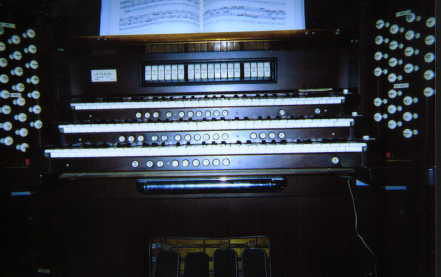
organist sits at the CONSOLE to play the organ. The
one pictured above has three keyboards, known from top
to bottom as the SWELL, the GREAT, and the CHOIR. Each
keyboard has its own set of STOPS which control which
sets of pipes the organist wants to use. Each STOP has
its own unique sound. You can listen to each of the
stops on the organ by clicking on them, below.
This
list of stops was recorded from the organ at the
church in Baltimore I served before moving to
Illinois. The ones in white only act in combination
with other stops. The ones in red either weren't
working or were never installed. But the blue ones, ah
yes, the blue ones are quite a combination of noises.
You can have fun guessing the names of the pieces I
played on each stop.
The
numbers after many of the stops tell how many feet
long the longest pipe in that section has to be to
make that sound. The longer the pipe is, the lower the
sound it makes.
| |
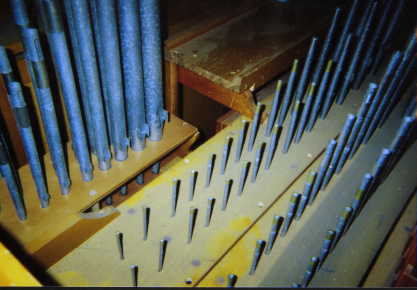 |
Some pipes are only a couple of inches
long!
|
A pipe
which is precisely twice as long will sound an octave
lower. Let's say you played a middle C using an 8-foot
STOP (the baseline, as it were). You could play the
same key using a 16-foot stop and it would sound an
octave lower. A 4-foot stop would cause the C to sound
an octave higher. Using all three stops would cause
all three octaves to sound while you played only one
note.
 |
STOPS
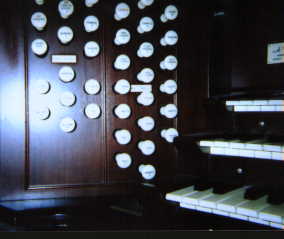
are activated by pulling the knobs to the right
and left of the keyboards on the CONSOLE. On
this particular organ there are five sections of
stops, two to the left of the keyboards, and
three to the right. The ones in this picture are
for the PEDALS and the SWELL. |
|
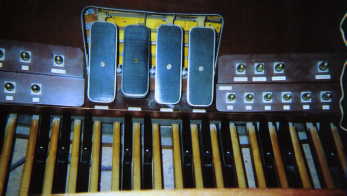
The
PEDALS consist of two-and-a-half octaves worth
of long, thin, wooden boards that are
depressed with the feet. Other than that, they
function just like the other three
keyboards. Although the lowest notes of
a piece (the bass) are often played with the
pedal, it is possible to play very high notes
with the pedal as well. It is not possible to
tell just by listening whether the organist is
using his hands or his feet to play a
particular note.
|
 |
The
organist doesn't just have to use one stop at a time.
He can pull several, or all of them at once. He can
also COUPLE one keyboard, or MANUAL, to another one.
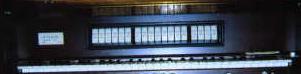
Above the MANUALS is a row of levers with labels like
"SWELL to GREAT." This means that the organist could
choose to take all of the stops he is using on the
SWELL and arrange it so that he can get all of the
same stops to sound when he plays the GREAT. If he is
using additional stops on the GREAT these are combined
with the ones on the SWELL.
This comes
in handy if, say, there is only one trumpet stop, on
the SWELL, and the organist wants to use it on one of
the other manuals, or more than one. He can simply
employ the trumpet on the swell and COUPLE it to the
GREAT or the CHOIR, or both at once.
If the
organist sounds like all his appendages are pretty
busy, this is a fair assessment. But he has help.
Below each manual are several buttons which can be
programmed with combinations of stops that the
organist wants to use on a particular MANUAL. Stops
can be turned on or off at any time during a piece,
but if the organist wants to change several at once,
it is sometimes more convenient to use the
push-buttons to instantly change the sound of a
particular MANUAL to whatever the organist programmed
in advance. If you want to change all of the manuals
at once, it is quite useful to use the TOE STUDS,
located above the pedals, which are, of course,
operated with the feet.
And
that's just the CONSOLE ! When you feel brave
enough, check out
the pipe room!
|