|
The Organ
part one -- The Console
part
two -- The Pipe Room
part three -- how to register
a Complaint
|
If
you didn't have a tree house as a child, the
pipe room almost makes up for it. At Faith
Community Church in Baltimore the pipe room
is divided into three rooms, one of which is
on the first floor behind the wall of the
sanctuary behind the organ console. The
other two rooms are on the second story and
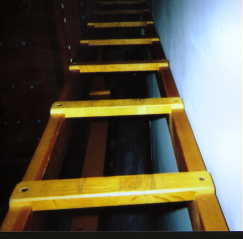
you would have to climb a very tall and very
narrow ladder to get to them. Let's take a
look...
|
|
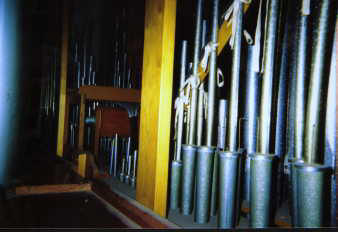
| As you climb the
ladder you will pass rows of
pipes belonging to the bottom
manual of the organ, the CHOIR.
There is quite an assortment of
odd-looking pipes waiting for us
before we have even reached the
second floor. At the far left of
the picture, in the shadows, is
a pipe which is so long it will
greet us again when we get
there. |
|
|
|
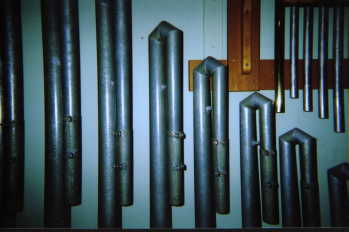
| Some
of the pipes for this organ reach lengths of 16
feet, which is absolutely necessary if you want
those wonderfully rumbling bass notes (some
organs even have pipes that are 32 feet long for
the octave even below that!) Unfortunately,
space doesn't always permit pipes that long so
they have to be bent, or mitered, as the ones at
right. Bending them like this doesn't have a
noticeable effect on their sound, and it means
that some of the larger pipes don't have to
start in the basement! |
 |
| |
 |
|
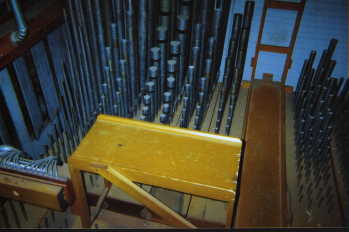 |
Once we get to the top, we are
surrounded by banks of pipes all connected to
the middle keyboard, the GREAT. The small bench
on the left is the only safe place to stand
since the floor is completely covered with pipes
on either side of the narrow walkway. |
 |
| |
 |
|
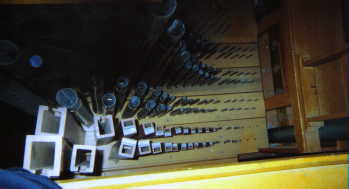 |
In
some places, the pipes are recessed about four
feet below the level of our walkway. Some are
square; others are made of wood. The ones at
left appear to have become twisted somehow. |
| |
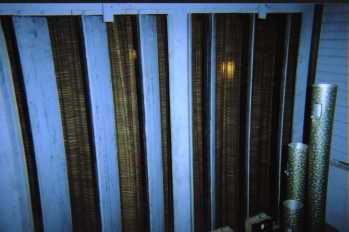 |
The
string stops are only available on the SWELL on
this organ. To get to those pipes we have to
enter the second room. The way can be
treacherous. Sometimes there is no floor at all
between ranks of pipes, and when there is one it
is covered by lots of delicate and expensive
pipes.
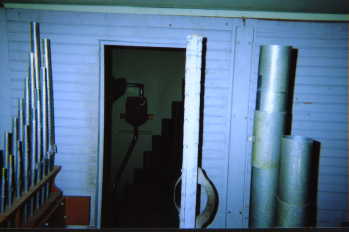
Our only view out
is through the slats at left. These can
be opened or closed gradually by the
loud pedals on the console. This is how to
make the organ gradually louder or softer. If
you look through the curtains you can see the
lamps hanging from the ceiling of the
sanctuary. We are about fifteen feet above the
sanctuary floor.
|
|
|
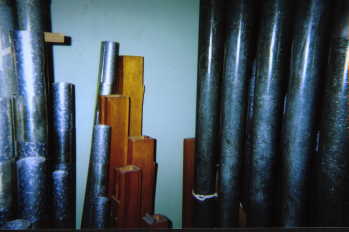
Plenty
of things can go wrong with an organ. Here one
of the pipes is leaning. It might still play,
but I suspect it has come out of its socket. The
organ's blower (giant fan) pumps air through the
bottom of the pipes, which are then activated
mechanically when you press a key, allowing air
to rush through the entire length of the pipe.
If the pipe isn't settled into its socket
properly, it can sound pretty weird. |
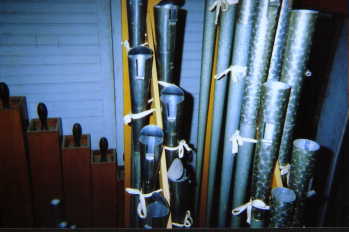
Pipes are
usually made of a tin and lead alloy. When the mixture
is 50% of each, the pipes appear to have spots on
them, like some of the pipes below. Others can be
closed at the top which makes each note sound one
octave lower than it would sound if the pipe was open.
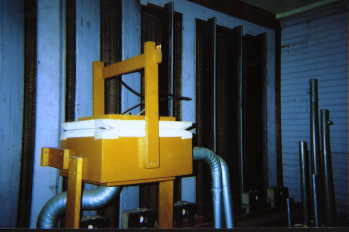
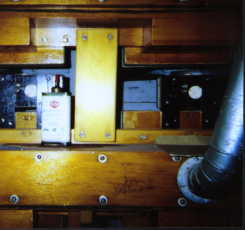
| Pipe
organs need regular maintenance. Since I am not
an organ-builder myself, I have no idea what
that oil can is for or why it has been left
there. Given the number of metal parts in the
pipe-room, though, it doesn't really seem that
out of place. What worries me more is the
shredded tissue I found in the other room. I
hope that doesn't mean Orville* is thinking
about taking up residence in the pipe room! He
might think twice about it after Sunday's
prelude!
*Orville is our
resident church mouse.
|
 |
on to Part three: How to
Register a Complaint
|