Looks aren't Everything...unless you are a
Celebrity
What did Beethoven Really look like?
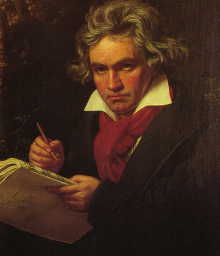
You've no doubt seen that "official" portrait of
Beethoven--quite serious, defiant, his eyes
blazing thunderbolts to the heavens, his unruly
shock of hair unkempt and wild, refusing to bow
to mere conventions us poor mortals use, or a
comb.
Is
that the real Beethoven? After all,
he lived in the days before flash
photography, and portrait painters could
stretch the truth a little, and they often
did, if their subject was rich, and ugly.
The truth is a bit complicated,
as usual, but it should be noted that well
before he died in March of 1827 Beethoven had
achieved celebrity status. People were
selling his portrait all over Europe.
|
 |
|
Ah, yes...then as now people
wanted to be able to see their idols. And
what they apparently wanted to see, more than
anything else, were the ideals he seemed to
represent. Not a mere man.
A
mere man is how the astonished music critic
Ludwig Rellstab described him upon meeting
him in 1825. Though surprised that
Beethoven appeared to him so ordinary, he
had to ask himself "why should Beethoven's features
look like his scores?"
|
 |
Of
the hundreds of works Beethoven composed, so
many seem to reflect a man with a sense of
humor, genial, affable, full of joy, relaxed,
and yes, by turns quite serious and profound,
particularly as he aged and his deafness shut
him off from society. And yet his works are
mostly described by his contemporaries as
bold, defiant, shocking, heavenstorming--as
some of them even seem today. But perhaps that
judgment is skewed by an over attention to a
relatively small number of his profoundest and
his most revolutionary works. |
| Beethoven was
born only six years before the American
Revolution and nineteen years before the French.
All of Europe was in ferment, shedding a system
of aristocratic government, replacing the
authority of the nobility with the powerful
economic clout of a rising middle class.
Democratic ideals were in the air. Beethoven
himself wholeheartedly subscribed to that,
believing that Napoleon had come to liberate
Europe. On arriving in Vienna, Napoleon's forces
bombed the city heavily, and a shaken Beethoven
changed his mind. |
| Beethoven was not so lofty
that he was above wanting things both ways. The
old order had placed accident of birth before
personal merit and denied any chance at upward
mobility. But Beethoven was not particularly
concerned when people incorrectly substituted
"von" for "van" and called him Ludwig "von"
Beethoven. While the term "van" is a regular
peasant prefix, "von" signifies nobility. Later
in life, trying to win custody of his nephew
Carl, Beethoven tried to use his "von"
designation to push his weight around. He was
embarrassed when the court discovered this to be
a ruse. |
 |
|
Beethoven moved easily in aristocratic circles
and was often patronized by its members. He
dedicated his works to them in return.
But Beethoven did not consider himself
subservient to any of them. One of his famous
diatribes is a rebuke to a prince in which he
shouts that there are hundred of princes
(there were) "but only one
Beethoven!" It is also said that
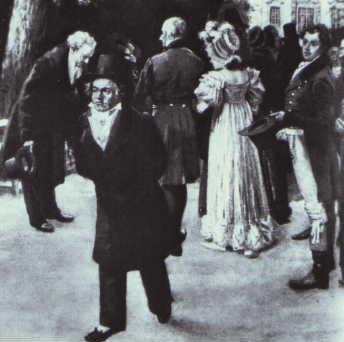
Beethoven refused to pay any respect to a
party of aristocrats near Teplitz (see the
above painting), while his walking companion,
the famous poet Goethe, stood at the side of
the road with his hat off. The source
for this tale is Beethoven himself, in a
letter dated August 14th 1812 to Bettina von
Arnim. The problem is that the letter may not
be authentic. Ms. von Arnim became quite
famous for her publications of letters from
both Goethe and Beethoven but does not seem to
have been above making history more
interesting than it originally was. Still,
many take the incident for historical fact
(and some date the incident from July rather
than August so that it actually occurred
during Beethoven's visit to Goethe and not a
month later when none of the parties involved
were in town!), and it does seem to illustrate
something fundamental about the character of
each (particularly the character we think we
know). So, did it happen? It might have--or at
least, we want it to have happened. Enough
then. It did!
If Beethoven's uncompromising
behavior was what most drew the attention of the
Viennese, it would be no surprise if the
Beethoven they saw in pictures began somehow to
resemble a defiant revolutionary. But
Beethoven's appearance, at least at first,
remained stubbornly unremarkable.
|
|
|
|
To begin with, his face
apparently had a few scars and deformities, the
results of a possible struggle with smallpox or
some other infectious disease which left a
lingering signature. Though testimony to this
facial misfortune is given repeatedly in print,
it is consistently "edited out" when his
portrait is painted.
The nose,
apparently, was revised as well, being a bit
larger than is commonly represented. The
biggest problem, however, seems to have been
with the eyes, which are often depicted as
gazing heavenward, steely, fiery. More often
in his portrait sittings he was probably
distracted. He hated to sit for them very
long, and, as there came a steady stream of
persons wanting him to sit for them, he
adopted a regimen of inviting them into his
study and then ignoring them, improvising at
the piano for hours and forgetting that they
were there. One of his favorite painters was a
man named Klober who came in unannounced, left
unannounced, said not a word, and simply went
on with his work while Beethoven worked. Like
a good naturalist observing Beethoven in the
wild he must have had to imagine something of
the character Beethoven's features would
assume had he been paying attention to the
proceedings.
|
|
Beethoven himself had favorite portraits. At one
point in his life it was the one on the right.
It apparently does capture much of Beethoven's
actual face, and was thought to be particularly
lifelike by Beethoven's inner circle. It begins
to show us the growing dominance of Beethoven's
favorite feature--his hair. Thick, massive,
unruly, like a lion's mane, this storm-tossed
foliage soon conspired with the furrowed brow
and the intensely concentrated eyes to give us
the Beethoven we know. |
 |
|
Because so many portraits of Beethoven were
copies of other portraits it was no great
difficulty at the time of his death for one or
two official versions to gain preeminence.
Helping this cause were Beethoven's close
allies, particularly a man named Schindler who
was so proud of his association with Beethoven
that he had the words "Friend of Beethoven"
engraved on his business card. Schindler went to
great lengths in writing to praise certain
portraits and condemn others, testifying as an
authority since, after all, he was an
eyewitness. |
 |
Schindler could have been a reputable source for
much Beethoven lore, but to suggest that he had
an agenda would probably be a severe
understatement. What is particularly interesting
is that he even overrules Beethoven on some
points. Of the portrait above, the one that
Beethoven liked "because of the way the hair was
done," Schindler exclaims that "Of all the poor
likenesses of our master, this one must be
considered the most plebian." But he was able to
share the wealth when it came to unkind words.
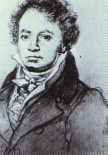
Regarding the portrait on the left, by one
Joseph Mahler, Schindler simply writes that it
was not worth making a copy because it was
"mediocre." Beethoven had thought enough of it
to write to the artist, who had borrowed it,
asking him to return it soon so that he could
give it to a young lady, hoping to procure
certain favors thereby. |
 |
Beethoven
does seem to have had a weakness for having
his portraits done, though he could hardly sit
still long enough for his artists to capture
more than a quick impression, and if they were
so impertinent to ask more than he would
give--well, they might have to finish the
portrait from memory! The unfortunate
Waldmuller dared to ask Beethoven to sit
facing an open window--a natural light
source-- and received condemnation from the
master. But then, Beethoven was less than
pleased with his face. Nor was he altogether
happy about the talents of some of his
painters, though he wrote "I cannot take
responsibility...for the misfortune to have
made a bad drawing of me" protesting at the same time that
his face was "not really that significant." It
could not have been easy being an icon
throughout Europe; "great is his horror of being
anything like exhibited" writes an
observer. Even after his death careful
attention was paid to capturing for all time his
study the way it looked at the time of his
death, as well as his face and his hands,
quickly sketched, while his ears were removed
and sent away to determine the cause of his
deafness. Copies of his final portrait
were immediately sold throughout Europe.
|
|
This
essay owes a great deal to Alessandra
Comini's very interesting book, The Changing
image of
Beethoven: A study in
Mythmaking (1987, N.Y.: Rizzoli)
particularly the first chapter. All of the
above pictures appear in this book, and all
are portraits of Beethoven! (in case you
wondered). The blatant opinions, however,
are mainly my own. |
|