| Mike's Ballpark hotdog review |
| Note: Nothing pleases a human being more than having an immovable sense of purpose in life. This author is convinced that he was put on this earth to travel to baseball stadiums around the country and determine the quality of the hotdogs served there, thus providing a desperately needed service to humanity. It is his mission; it is his quest. And you are quite welcome. You can send money if you like, but it is not necessary. If even one person does not have to experience a bad hotdog at a game, it will have all been worth it. |
 [email protected] |
The present series of reviews have been arranged in chronological order. The adventurous-hotdog-wanderer (a term which sounds much better in German) encounters these stadiums in seemingly haphazard sequence and writes about them as soon as he is able to metaphysically unpack the experience (often a year or two later). However, it has come to his attention that many people consider this page a resource for their own hotdog encounters--in fact, this portion of the website has experienced a steady stream of inquiry, in contrast to the rest of these pages, which do, in fairness, generally deal with unsavory subjects like classical piano music. Thus we provide an index, as our reviews have now swelled to a small handful. Once a quorum is present; that is, a small sampling from each division in baseball, league standings will no doubt take their place, according to best hotdog. Meanwhile, the various divisions in baseball are mixed haphazardly. I hope purists can stand it.
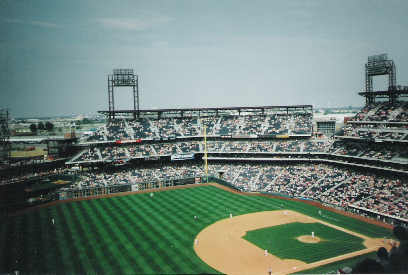
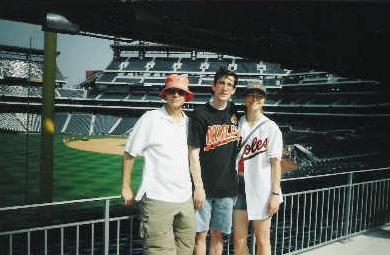
Bank One Ballpark -- Philadelphia July 4, 2004
| I have been to the epicenter of patriotism. It is
not possible to get any closer to the heart of Uncle Sam than to sit in the
ballpark in Philadelphia on a sunny July 4th afternoon watching baseball and
munching on a hotdog. Well, alright. My mother wasn't there. And there wasn't any apple pie for desert, so maybe I'll have to hit the trifecta another year. But you've gotta admit, this one was in bull's-eye territory. If you haven't been to the aforementioned ballyard--have you seen the American flag? Well, it looks very much like that. Well, not in size, so much, or in shape. But you've never seen so much red, white, and blue in your life. Rather clever of the ballpark's designers, too. You see, the Philadelphia Phillies are, for reasons of eye-safety, I'm guessing, only allowed two basic team colors, and they've chosen red and white. But no matter, because the fans call each other before the game to make sure that there will be an even split between those sporting red and those wearing white. The seats are all blue. Now you see where I'm going with this. I want you to imagine Baltimore's Camden yards on a potter's wheel. Two giant hands descend and slowly apply pressure to the sides of the stadium. What happens? Well, of course the pottery gets taller. Now the potter is inserting hundreds of little staircases so the patrons can ascend to levels well above anything the Babylonians ever dreamed of. If you haven't been to Baltimore's Camden Yards, imagining any recently built ballpark will do, since they're all modeled on Camden Yards. Jacobs Field in Cleveland is what happened when a group of businessman, admiring the finished product in Baltimore, decided they could jam about 5000 luxury skyboxes in there to help pay Albert Belle's salary for a year. Philadelphia's version is a vision of what a stadium would look like if it were more of a skyscraper. I liked the place. And I've been all the way to the top. Now the field on the other hand--well, the field, though a bit roughed up (probably from outdoor concerts) was in the main a perfectly nice ball diamond- it just happened that, on this particular occasion, there was a bit of a problem with the outfield wall. Somebody thought that baseball stadiums didn't look enough like superhighways, so they put up a little transparent guardrail at the top of the wall. Behind said rail was what I will magnificently describe as a group of rocks. Sometime in the second or third inning--my prodigious memory has denied me access to the actual details--a member of the Phillies hit what was charitably described as a home run by the second base umpire. In actuality, the ball hit the top of the railing, bounced straight up, and was eventually caught by the Baltimore Oriole's center fielder. It should have been a ground rule double, but by the time the whole mess had been overturned on appeal (appeal is the technical term for what managers do when they kick dirt on the umpire) the runners had all returned to the dugout, and in an effort to achieve world peace, the umpires, instead of returning both of the players who were on base at the time to the place they would have ended up had the correct call been made, decided to make up a rule which allowed Philadelphia to score a run. But it is probably my crass partisanship that causes me to state that they decided to make up a rule. Of course, strictly speaking, umpires can no more make up rules than the New York Yankees can blow a playoff series with the Boston Red Sox. The run didn't matter, which is why I hereby magnanimously forgive everyone involved, including the Philadelphia chamber of commerce which is obviously worried that some of their finest citizens might get the urge to migrate to Tucson unless they provide free samples behind the outfield as a warning not to romanticize desert environments. Everyone was just doing their jobs to the best of their ability, including the Orioles, who handed the Phillies a loss that afternoon, 9-2. Oh, and I loved that hotdog. Very beefy. |
Jacobs Field -- Cleveland, Ohio June 28, 2004
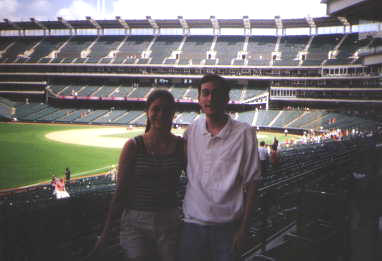
| Despite having spent eight years of my life in Baltimore, whereby I became a naturalized Oriole's fan, my original hometown is in the vicinity of Cleveland, so when Kristen suggested we attend a game against the Orioles while on a trip there, I couldn't say no. Thus we re-enacted the War Between the States; the Yankee boy with his loyalties to the Red and Blue, and the Southern Belle fiercely defending her boys in the Orange and Black. |
|
| If you are in the mood for something with the
consistency of paste, the taste of recycled poster board, and an appearance that
will make you marvel about what they can do with plastics these days, the
hotdogs at Jacobs Field are your item. If you are not so inclined, not to worry.
You can always wash it down afterward with something like the hottest, flattest
soda ("pop" in the Midwest, "coke" in the South) I have ever had the inverse
privilege to consume.
Visitors to Jacobs Field (affectionately known as "the jake" by Clevelanders--Dick Jacobs, the club owner, felt compelled to write a memo to the media trying to encourage/demand that this kind of thing be stopped since the phrase is often used colloquially in reference to a toilet, but to no noticeable effect) --Visitors to Jacobs Field will bask in the splendor of the view of the Cleveland skyline, and the relative spaciousness of the lower levels as they make their plebian way to the fifth (yes) floor in order to bake in the northern Ohio sun and ponder incredulously just how small it is possible to manufacture a hotdog which costs $3.75. Jacobs Field is also known for its massive wall of luxury sky boxes which contribute to a more gargantuan look than some of its retro-ballyard brethren and for the healthful effects of the air since far-sighted legislators have decreed that no smoking is to take place on the grounds. These same legislators were kind enough to pay for the stadium by levying a cigarette tax so that smokers wouldn't feel entirely left out of the loop. I miss Cleveland politics. Now that the Indians have ceased their dizzily winning ways and returned to a "rebuilding" period (the last one ran from 1954 through 1994) it is possible to find a seat on short notice, particularly if you encounter one of those characters who patrol the grounds near the park who, upon opening their cloaks, seem to have just come from a hostile takeover of Ticketron. However, legal ticket purchase has its charms and usually, as on this day, leads us to the dazzling rooftops of Jacobs Field. Cleveland is a city bedecked with clouds, several of whom have residence permits, but persons who think that this exempts them from having to wear sunscreen had better beware. There are colorful characters inside the park as well, such as the man with the bass drum who comes to every game and sitteth in the center field bleachers. Verily, if the Indians are lucky enough to get men on base, the drum starts to pound and the cheering augments accordingly. Folks love their home town team, and if you brought an infidel with you who dares to cheer for the opposing side there can be nasty stares from the faithful. At least my hotdog isn't judgmental. It isn't very filling, either. Persons who have spent portions of their lives at McDonalds and who feel subconsciously cheated if their foodstuffs aren't mashed flat and lukewarm will love the fare in Cleveland where they take the same approach. If you chose to compound your injury by rooting for the Baltimore Orioles that afternoon, you would, as a Panglossian byproduct of acquaintance with suffering, come away with the inevitable pains of having built a little too much character for one afternoon! Despite my not wearing a Cleveland Indians jersey that day in what was surely one of the most romantic gestures ever recorded, the Orioles chose to lose 14-0, something that must surely be explained, not by an appalling lack of pitching, but by the fact that before the game members of the Orioles must have been locked in a room somewhere in the catacombs below the ballpark and forced to consume the local hotdogs. |
Camden Yards -- Baltimore, Maryland September 25, 2004
|
Baltimore, Maryland seems like the hotdog capital of the world, to judge by the number of commercials for the Oriole's most official product, many of which feature the Oriole's favorite son Cal Ripken Inc. as spokesperson, that radio listeners have to put up with in a typical inning of their favorite pastime. Part of me wants to pan their dogs without mercy to avenge my ears and my sanity. But the hotdogs are not that bad really. Not as good as the ones in Philly, and way better than the ones in Cleveland, which currently puts them in 2nd place in the rankings, for those of you scoring at home. If you are not scoring at home, quit goofing around on company time! |
| Those of you laboring under the delusion that
Baltimore is not the center of the baseball universe had better get your
doctrine straight before meeting my wife, Kristen. The woman bleeds orange
and black (I married her anyway). The Orioles, for their part, were so depressed
when their number one fan left town some years ago that they haven't had a
decent season since. Although the quality on the field may be lacking, the quality of the field, and of the ballpark experience in general, has always been high, thanks to the loveliness of Camden Yards, America's first atmospheric, throwback-to-the-day-when-everything-was-pure ballpark. Now, of course "everybody is doing it." But Camden Yards was the first to feature a smaller seating capacity than the thunderous megadomes of the Eighties, friendlier sightlines through lack of massive poles every six feet to hold up the third deck, and a portion of the stadium being cut away to feature part of the civic skyline. Now built to blend harmoniously with and celebrate the surrounding city instead of trying to swallow it whole, stadiums have become known as ballparks again, and, except for that thing with the steroids, a few season-threatening labor disputes, and crybaby owners making the front pages crank every now and then, baseball has regained its innocence. LA!LA!LA!LA! Camden Yards dates from 1992 and, with its characteristic warehouse watching over right field, it is a wonderful place to view a game, provided it is not August and there is a breeze. Oriole Park and I may have gotten off to a bad start (my first game was in the aforementioned sweltering August), but since then I have witnessed many games there, and I could think of nowhere better to hold the business meeting I had in mind. My "clients" were Daniel and Margarita, two friends of mine. The purpose of the meeting was to announce my impending nuptials. Since the lower bowl of Oriole Park is generally stuffed with business persons entertaining clients this seemed especially appropriate, even though we were seated in the upper regions, the only place being available to the people who are ::gasp!:: there to watch baseball! I waited until the fourth inning to make my announcement, giving the Orioles time to show their skills, and, on this occasion, suggest that they might win the ballgame, which, if I recall correctly, they did, despite my inattention during the middle innings. After being congratulated and closing the deal with my potential groomsman, we went back to the business of the game, in which, I believe, the Orioles staved off a 9th inning rally (or allowed it to happen, depending on how you wish to look at it) before closing the door on the hapless Tigers. But you wanted to get my opinion of the hotdog. It was in Philadelphia, some months previous, that I suddenly turned to Kristen and announced that it would henceforth be my passion in life to travel the country consuming and then reviewing a representative specimen of every major league hotdog known to exist. She has apparently forgotten this promise because not a month later she said she'd marry me. But on this afternoon, so far apart, I was thrown upon my skills as a hotdog aficionado flying solo, and in the company of two friends who are not hotdog lovers, one of whom was mainly there because she likes the mascot. Yes, the Oriole bird is really something. And so was the hotdog, which was long gone by the fourth inning so I can assure you that the results of my announcement did not affect my opinion of it. I have also had the opportunity to test the Oriole dogs under many different conditions so I think I have a pretty good bead on them. They are not the best, certainly; but they do offer a couple of things that dogs in other parks only wish they did. One is the price. I did not buy my hotdog inside the park. There is a street alongside the park on which vendors ply their trade and hotdogs cost only--and I realize this is big news in the stadium hotdog world--only a dollar. If you want chili on your dog I think it is a little extra. This is another great thing. To my young friends reading this: I have learned as I get older that a number of things that we thought life guaranteed us are not so, and this includes the right to get chili on your hotdog. Some stadiums do not bother with this. I do not know if they bother with it inside, where the price is considerably higher. I suppose if I wanted to do a purely scientific study I might have to purchase one. But unless I get a grant from the National Institutes of Health I will not empty my pockets for such a thing. I recommend getting your hotdog outside the park, where the relish and the mustard flow and the skies are not cloudy until the 3rd inning. If you are going to Oriole Park at Camden Yards (the stadium's full name, which I only use when I am angry with it) you might run into us. I recommend bringing your sunscreen. The woman yelling is Kristen. |
Yankee Stadium--New York City July 4, 2005
|
|
|
|
|
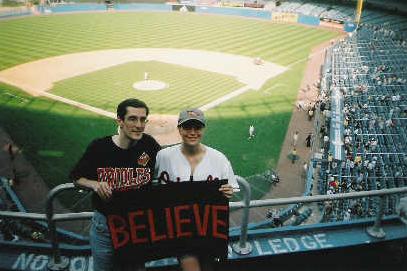
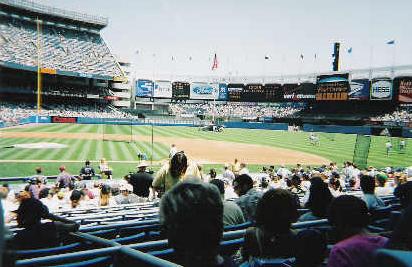
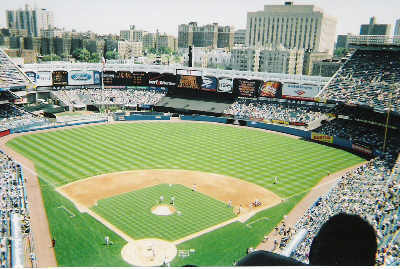
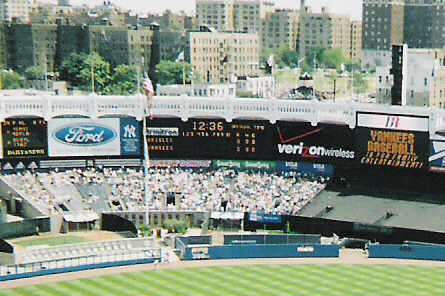
| After a couple of summers spent preparing for the undertaking (deep breathing
exercises, yoga, meditation, and consuming sweetened beverages) it was at last
time to visit that northeastern Nineveh* whose symbol is the indomitable New York
Yankees Baseball Club. Yankee stadium has traditionally functioned as a house of
horror for my partner's beloved Orioles; within the great temple that Babe Ruth
built with his bare hands are the bloody remains of many Orioles' losses, some
by umpire, some by a scant resemblance to pitching, others by failure to field
the ball cleanly in the late innings of a close game, some simply because the
Yankees felt like scoring about 20 runs more than the Orioles on a particular
afternoon. But I digress. You are waiting in feverish anticipation of my thoughts on the hotdog. Wait no longer. I ordered my hotdog outside the stadium this time. Judging by the length (they come in foot long and polish sausage styles), I determined that it was necessary only to order one and I would be satisfied. As it is, I think I am still paying the final installments on my monthly credit card bill. The hotdog they serve in New York is a perfect representative of its environs. It does not sneak up on you. The moment you bite into it it tells you everything it wants you to know and if you don't like it that's just too bad for you. It is unabashed. It does not unfold slowly or show you new things by degrees as you pursue your quizzical art-lover's relationship with its reconstituted mysteries. It is just there, all of it at once, and with no reservations that, in deference to your unfamiliarity, it might do better to introduce itself to you and then wait to practice its magic on your digestive system once it has gained your confidence. It is spicy, but it did not cause heartburn. At least, I'm pretty sure it can't be traced back to the hotdog. The hotdog may be no pilgrimage to Parnassus, but the city of New York continues to surprise. Its citizens were on their very best behavior that day; there wasn't a single shouting match to be had anywhere. It was expected that New Yorkers would not be too threatened by our Baltimore Oriole's jerseys, any more than Goliath felt the need to hurl oaths at David, preferring instead to decapitate him amidst jokes and good cheer; but their genial warmth was surely the result of storing it up for a long time. True, the remarkably friendly fellow with his three kids all decked in Yankee pinstripes we met on the subway turned out to actually be from New Jersey (aha! I couldn't help thinking) but everyone we met turned out to be in a similarly good mood, and, as usual, quick to help the out-of-towners with an encyclopedic knowledge of the best way to get someplace (under normal conditions, New Yorkers will tell you where to go whether you've asked for directions or not). A festival atmosphere prevailed in the Bronx that day; as if to show that even New York can provide a foreshadowing of heaven if we would stop visiting commerce on each other. The sun smiled down on us, but we did not mind its attentions with the roof to shelter us. It was our privilege to sit in the very last row, at the top of the stadium, the land they call row X, just to the right of home plate. It was a rare day, and the Yankees treated us to a long game to reward us for making the four hour journey. The hotdog was gone by the time the game started. It did not overstay its welcome, although there was a pleasant and authoritative aftertaste. In the fourth inning I went to purchase some lemonade and our pitcher was so good as to plunk the Yankee batter so that both managers and all the umpires had something to talk about for five minutes so that I would not miss any of the game. And all because I gave New York a bad review a few months ago. This royal treatment by the city of New York leaves me slightly sheepish about letting fly with any criticism. It may be nitpicking, but I think putting Sinatra's recording of "New York, New York" on endless loop after the game is in poor taste. (Three or four times through would be enough). Finally, I should like to apologize to George Steinbrenner, the owner of the Yankees, and also to Peter Angelos, who owns the Baltimore Orioles. Both of them were having birthdays on the July 4th holiday, and I neglected to send cards. I hope they didn't mind splitting the ticket monies instead. |
R. F .K. Stadium Washington, D. C. July 23, 2005
 |
 |
By failing to order a Fenway Frank when he had the chance, Michael Hammer caused a ketchup manufacturer in Dubuque to layoff one of his truck drivers, who would later murder an ant on the sidewalk! Now he is doomed to wander the earth in search of the perfect hotdog (Michael, not the trucker) returning to his home ballpark only once in seven years. It is only the love of a good woman that can save him and break the curse. But through an accident involving radioactive nachos, she too, must now wander the National league. If only he could get a job writing blurbs on fast-food containers and save them both! |
|
Before I begin my review I must
address something which wounds me deeply. It has come to my attention that my
writing style sometimes resembles that of a pretentious 19th century author and
that this in no way ennobles the very important subject of hotdog connoisseurage
(spell check thinks that isn't a word. Very well: connoisseurocity). I shall
call your attention to this unjust criticism so that, in the time-honored
tradition of presenting a speck of one's own criticism in the public view,
I may dispatch of it forthwith by a finely-toned torrent of words. It is all
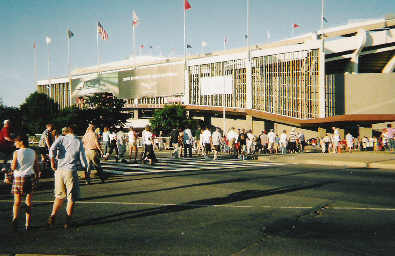
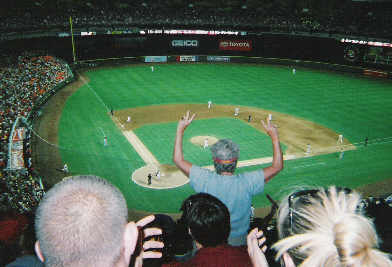
huey. Actually, Robert Fitzgerald Kennedy Stadium in Washington, D. C., comes closest to resembling a 19th century novel of any of the modern National League ballparks. It is vast, it is ungainly, and toward the end of the experience you begin to dimly perceive that all of the corridors are somehow related to one another, though the author of them has ingeniously saved this revelation for the very end. My greatest acquaintance with these hallowed hallways came during the sixth inning, when I went in search of a repast and discovered several long rows of people twisting and twining hither and of course thither, their distant minions fading into the ineffable shadows of concessionary existence. I purchased my hotdog inside the stadium this time because, although they also sell them outside, there are great big signs posted at the entrance to the castle to the effect that it is illegal to bring any food inside. I imagine Peter Angelos may be behind this. He owns the Baltimore Orioles, thirty miles to the north, and was virulently opposed to his neighbors to the south setting up shop near enough that they might draw away some of his pilgrims from the southern reaches. What better way to kill off a team than to entrap its most trusting fans in a series of silly regulations and bureaucratic impossibility! It is cheaper than hiring a Minotaur.* The hotdog itself is hardly worth writing about; it did not greet my taste buds with anything particularly welcoming, although it was not particularly awful, either. It closely resembled a hotdog that I could have bought at the store, 10 to a pack. It was slightly warm, which does not do honour to its name, though no great injury, either. It was sort of so-so. More or less. Definitely. Back we twisted among the crowds and the maze to our seats high above the carnage happening on the field. Baseball carnage can happen suddenly and then remain in the psyche the entire game, recalling itself only to memory. All of the actual scoring occurred in the first inning, when my fiancée was busy getting her Italian sausage, and then very little happened thereafter, giving us plenty of time to reflect on the staleness of the nachos and the watered-downness of the lemonade. But if you are in a historical mood, R. F. K. offers one of the few remaining monuments to that period of history when ballparks were large and round, with pillars and long concrete ramps. It is only a temporary home for the Nationals; a fashionable brick, retro ballyard is being built and will be ready in a few years so that all of this Romantic foolishness can be forgotten. The Nationals won the game, incidentally. I don't care much for the name of the team. Washington has had two teams named the Senators and both were atrocious. I can understand their desire not to repeat their errors, but the term national suggests to my mind "foreign national" meaning not actually a citizen of the United States and usually when the term is brought to our attention it is because they have done something dangerous. The legions of productive and peaceable ones are never in the news. I also think this is kind of a copout; given D. C. 's particular characteristics as a town, they could have come up with something that didn't sound like a generic recapitulation of the name of the league in which they are playing. A while back, a satirical article in the paper suggested a few names for the team. My favorite was "the Washington Gridlock". |
Coors Field Denver, Colorado August 9, 2005
 |
 |
 |
| The ability to review a ballpark hotdog is not one which is given to
everybody. Having the rare taste faculties needed to carefully sort out the
innumerable ingredients masquerading as something else in combination with you
don't want to know what, to be able to decide, on a moment's notice, whether
this hotdog is worth consuming by the masses of persons who are depending on you
to render a virtuoso's judgment because they themselves, poor souls, realize the
inadequacy of their own ability to form an opinion about such an important
matter, and then requiring that those unfathomably fine-tuned impressions be
translated into the finest assortment of adjectives and memorable phraseology
that will give the consumer pleasure all over again and perhaps not fall too
very short of approximating the delectable sensory experience which the hotdog
itself provided, a thrill which is worth the probability that your life will be
shortened as a result of eating it, this is the enormous responsibility of the hotdog critic,
even to the point where he puts his own life on hold while searching for an
elegant manner in which to conclude the sentence in which you are presently entwined.
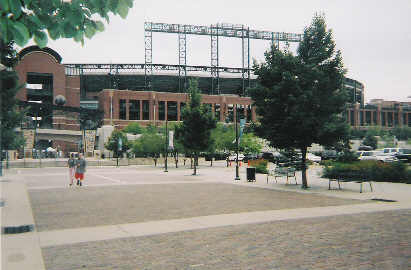
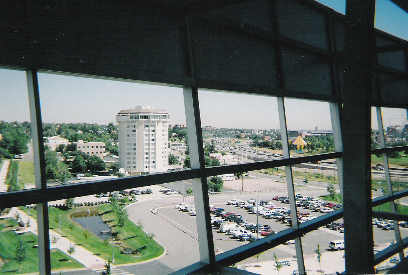
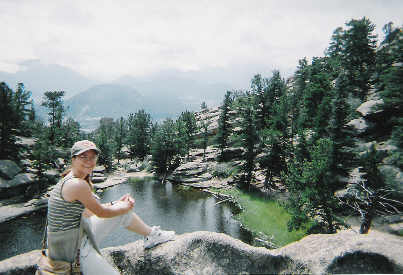
This brings to mind a passage from Boethius,* in which he declares that there are three kinds of people having to do with music (stay with me here). The first category are those who perform it. He decides that this group, because it spends all its energy on physical labor, is "completely lacking in thought." The second group, the composers, are similarly suspect, because they use "a natural instinct" rather than "thought and reason" to write songs. But the third group, ah, these are the critics. "Because this group is devoted totally to thought and reason, it can be considered musical." Thus, it is not those who create the music or those who interpret it (i.e., perform it) who are the musicians, but the ones who sit in judgment over those who do. Do you see my point? It is not the hotdog manufacturers who are the true artists, or the vendors who bring them to you (for three easy installments of $8.95) but those rare individuals who devote their lives to determining whether that hotdog is worthy of the American consumer. Of course, I flatter you. If you were really worthy you would not need my learned opinion. It is I alone who have developed the taste-capacity to sort the truly great from the not-so-truly-great, and have, impelled by a great duty, spent many hours using my finely-wrought talent for good. Viva the masses. A burden of this magnitude, however, can benefit greatly from having a supportive second; often when you are dueling with a hotdog, many of the details of mundane life fail to impress themselves on you, and being in the grips of a creative coma at the wrong time may cause you to lose your bearings on the way back to row EE seat 605B, or wherever the impudent ticket seller, unaware of your colossal importance, has chosen to seat you. No matter, hotdog vapors travel well through the upper atmosphere. It is well, for these and sundry other reasons, that I was able to attach myself to my dear wife, who is fully committed to my mission, and was just as excited as I was about planning our honeymoon so that it allowed for a trip to the ballpark. It was unfortunate that it chose, from the third inning on, to indulge in a light rain, and to import some of the frigid Rocky Mountain air directly to our seats, also singularly unfortunate that our once hometown Baltimore Orioles were on the Jumbotron as my wife was returning to her seat; they were getting clobbered again. This always affects her deeply, poor thing. However, the atmosphere before the game was smashing. The air was still somewhat warm, the sky clear, and the promise of an attractive new ballpark to see--having arrived over an hour early we had plenty of time to promenade blissfully around the park, including a lovely trip to the rock garden out in left field--all this contributed to a relaxed and happy frame of mind. I mention all this so that when I tell you in a moment what the hotdog tasted like you won't think I was influenced in any way by the brilliant sheen of being on a honeymoon or the pleasant incidences of that moment, and so that, in future installments, your trust in my integrity will be that much greater. It was poor. The man who sold it, outside of the stadium, where he had his own fascinating monopoly (not another cart visible) was well-mannered. And he gave the hotdog a short recap on the grill before matching it with a bun and surrendering it to its new owner, so at least it was warm and mediocre. If it were cold, I would blast it. Instead, it was merely harmless. But if they think they can fool me with a plain old grocery store hotdog when we are entitled to expect more they are dealing with the wrong Doctor of Hotdogology. You don't go to Major League ballparks to see Uncle Steve try to shag flies with moderate success; you want to see the best athletes make the most scintillating plays, so why should it be any different with the concessions; if they are not made of really fine meat, they should hide this inconvenient fact as best as possible and at least try to give the appearance of specialness. Employ hickory smoke and mirrors if necessary. P. T. Barnum could teach the folks at Coors Field a thing or two about how to do this (if he weren't currently dead). Of course, I did not buy the inside-the-park $8 extravaganza they call a Rocky Dog. I am still waiting for my grant from the Hotdog Research Foundation, and besides, baseball has the element of Democracy, illusory or not, and culinary greatness should not be reserved for merely the upperclass hotdogs. So I stand by my decision to again sample the economy size. The Rockies themselves, apparently living on ballpark hotdogs alone, were summarily destroyed by the Expos, 14-3. |
Shea Stadium New York City May 23, 2006
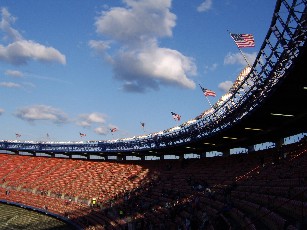   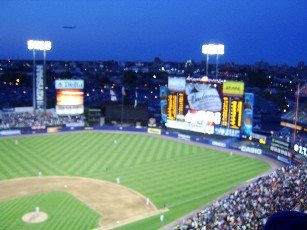 |
| One of the fun things about Shea is the airplanes that go by every minute. It is as if you are at an aquarium for 747s. (right-hand picture--you can barely make one out to the right of the left light tower) There is also a cheesy "big apple" that rises over the left-center wall after every Mets homerun (and lights up). For additional fun, we recommend catching a game during 40mph winds. |
|
There is a very human tendency, observable in all of us at some time or other, to imagine the glamour and romance that goes with someone else's calling in life, and to disregard the possibility that there may be a price to pay for it after all. It is easy to imagine, when you see someone practicing their craft at a high level, making it all look so easy, that there might not be much effort involved, even a great deal of pain. But, I assure those of you, comfortable in your living rooms at home, perhaps with a favorite beverage by your elbow and your feet propped up as you stare contentedly into your monitor, that someone has to go forth and do what is often some very dicey field research in order to bring you the very best in hotdog criticism, and then take all of that suffering and make entertainment out of it. This may, indeed, be very close to the definition of great art. "Well, Sancho" I said gallantly, "let us return to New York. We shall see, while there, if the city is still under the strange enchantment which made everyone so nice to us on our last visit."* Under the influence of this pleasant thought, we decided to make the four-hour journey from Baltimore by car up I-95 and into the heart of Queens. Having spontaneously determined that we would not send Erasmus to college after all, we were able to spend what would have been the vaunted "college fund" on the tolls necessary to get us there. I should point out, before you have a similar experience, that the Lincoln Tunnel and Queens Mid-town tunnel together cost $10.50; the Varrazono bridge by itself is $9. This led Sancho to much swearing, but in fact, it is slightly cheaper to go this way since the next bridge in the series sports the absolutely latest advance in bridge technology--somehow the architects found a way to make the bridge stay up without putting tollbooths on it to distribute the weight properly (like capstones). This makes it free, and also means that you will pay roughly $20 to get into and out of Queens, give or take $3. Occasionally, I have the irksome impulse to be useful, so I am linking to a map of the area around Shea. There are no signs telling you where to go until you don't need them anymore, practically. You should also know that Shea stadium does not like to consort with other buildings; until you are right in front of it, you will think you are going for a drive in a national park. True, it is near the tennis center, but that building also likes to make pretensions of rurality. Upon our arrival at Shea, we were instantly struck by the fact that the weather was behaving rather badly. Congress has yet to pass a law guaranteeing decent weather at baseball games; since they have not acted, I am proposing a constitutional amendment to that end. The wind was the main thing; twice it caused me to leave the stands and go in search of hot chocolate and blankets. Shea having been built before the glorious era of unique civic ornaments that have sprouted up since the 90s like massive fast-food collectibles (collect all 25 cities!), there were a lot of long ramps involved. Several vendors did not offer hot chocolate per se, merely the opportunity to read said item on their overhead menu. This in itself did not warm me, nor did the Mets' onfield performance, but the exercise I got running up and down 1000 yards of meticulously manicured asphalt ramp did almost make the hot chocolate unnecessary. When I returned to my seat, my squire was freezing. I explained my little adventure, including the fact that the Mets' team shop was out of Mets blankets, even if they probably cost $400 a square yard. My squire tried to be positive. "Well, as they say, 'hotdogs cost extra when there is no one to buy them,' and 'it's a poor blanket that blows away in the third inning,' and 'the hot chocolate isn't so hot when there's no chocolate in it.' No amount of proverbs could keep Sancho warm, so we left after the 7th inning. The Mets miraculously tied up the game in the 8th, after a lackluster 7 innings, so determined were they to keep playing far into the night and until the temperature got down to zero. We heard the next three innings on the radio until we arrived at our overnight lodgings. The Mets were still playing. About three innings later, they finally decided they had entertained us enough (by television now) and hit a solo home run to win the game. We had met the Mets. As for the hotdog, it was pretty good, if much too thick-skinned. Continuing my radical tendencies, I ordered from a stand (inside) that sold Nathan's brand, even though Hebrew National claims to be the "official hotdog." It was warm, and spicy, as you would expect from a New York hotdog, and it filled me up. But it was a distant memory by the 13th inning. $10 worth of hot chocolate later. |
U. S. Cellular Field Chicago, Illinois June 6, 2007
 |
 |
 |
 |
| The hotdog
squirmed and squealed in its apathetic bun, ketchup glistening like beads of
sweat on its frightened brow as this reviewer opened his mouth to reveal a
particularly nasty set of positionally enhanced bicuspids
eager to tear asunder the meticulously crafted factorily precise cohesion of
cereal and meat products that considered itself a hotdog. "Please! Don't eat
me before the third inning!" it bargained, clinging to the only corporeal
form it knew. "Let me see the Sox bat around once." Unmoved, the reviewer
closed in. I am not a Make-a-Wish foundation for hotdogs, he
muttered.. Please!" The dog clearly lacked the cognitive calm necessary to
complete another sentence. It was panicked. "...Noooooo!" it screamed as the
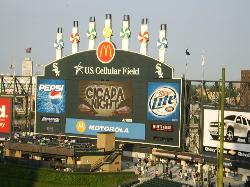
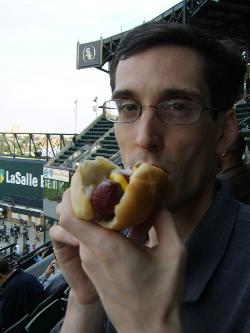
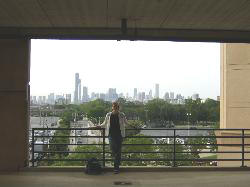
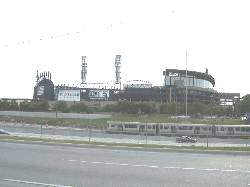
merciless jaws closed around it. Got your attention? One must indulge in a bit of picturesque fiction nowadays in order that the dry facts may go down easier. And the dry fact is that I did not find this hotdog particularly edifying. It concerns me that in an age of economic despair, with the noise of distressing foreign events growing increasingly clamorous, that someone does not take the trouble to ease our burdens by producing a really fine hotdog. Quite possibly they feel that they are doing their civic duty if they produce something which large numbers of (captive) persons will agree to consume, even giving something approaching an hour's wages to do so. This does not, however, excuse them from the moral responsibility to satisfy digestorial requisites of a higher order. It may be capitalism, but it does not sit well with those who feel a higher calling in life is necessary to its constitution. Critics, whose individuality, etched sharply into the skyline of humanity, calls forth from deep within their souls seismic waves of intellectual passion, crying out against the lazy, the contrived, the obvious--lone wolves who submit themselves to bitter attack so that humanity may lurch ever forward in its quest for light and love--they are those who feel a natural enmity with those things whose existence is based solely on what a pacified public will accept without bloody revolt. The hotdog was not abhorrent--it was far worse. It was Biedermeier. But if we can't have bread (the bun didn't finish well either), we can have circuses. Somewhere in the depths of their aesthetic souls, the White Sox knew something was wrong. They reached down deep inside, and fetched out....Cicada night. Oh yes, believer. If you've never been to a minor league ballpark, with its myriad attendant promotions--sausage races about the 3rd inning, bowling for pizza coupons in the fourth with giant inflatable rubber balls and pins--there is still a chance that you may be assaulted by such practices in some of our major league ballyards. Such was this celebration of our septidecca-annual brethren's descent on mankind. It included horrendously distorted cicada noise on the public address system, and a giant dancing cicada mascot before, during, and after the game (if you include my nightmares). Still, if you've never seen a giant cicada doing "Y-M-C-A!" you are no doubt kicking yourself for not having been on the south side of Chicago one night in June. You will have to wait 17 years for an encore (and probably at a different ballpark with a different corporate logo on the front--corporate America doesn't like you to get too settled in). On the other hand, you can hear that perennial hit, "the monster mash" on the internet right now, surely. You'll have to imagine the choreography but the distortion can be achieved by getting cheap speakers and turning them way up. If you feed them directly into your ears until you lose coherence, you will begin to imagine many things. You may even be able to feel the cicadian rhythms (sorry). This last piece is among the auditory hallucinations that still visit me at night sometimes. Do you see the kind of things I go through to get my readers the truth? Of course, whenever such impressions get too overwhelming, I can always picture to myself a long, relaxing stretch of I-57, the most deliciously boring stretch of highway ever conceived, east of Iowa. It was necessary to brave two and one-half hours of this modern hymn to concrete in order to find ourselves at the southernmost transit station for the journey into the interior. Thus we had the opportunity to experience Chicago's public transportation, which seems mostly to be in working order, except for the parts I would rather not talk about, and to revel in the orange barrels in bloom along the highway. If you are planning a trip in 2008, you should know that Chicago is under construction (not just parts of it). You might need to detour through Milwaukee. |
Busch Stadium, St. Louis August 5, 2008
| From time to time I get barraged by a long line of people all dying
to know what it is like to review hotdogs for a living, and whether I
might share my insights with them so that they, too, might be better
equipped to render their own well-informed, or at least immovable
opinion on whether a particular specimen is worthy of their neighbor's
consideration. Perhaps they are looking for a few useful catch-phrases
to drop at the next barbeque in order to seem more astute than their
associates in matters of high cuisine. Maybe they are afraid of being
engaged in a conversation when the subject matter inevitably turns to
hotdogs, America's next dietary craze, and looking stupid when they have
nothing to say about them and there is no time to punch up wikipedia on
their cell phones for
help. Ever since mankind discovered that mass popularity could be relied on to generate wealth for people who know how to call it forth, there has been a trend toward making everything which was once limited to guilds or practicing professionals the hobby of everyone. This helps the professionals because it stimulates interest in their area of expertise, and it helps the general consumer with his self-esteem since it essentially places him on a par with someone who, by years of application and expense, would in dark ages past have been considered much more qualified to practice his art. But most of all it creates dollars for those who are wise enough in the ways of the world to sell a few harmless trade secrets for three easy installments of $9.95, while keeping the more important ones to themselves so that they are not rendered completely unnecessary by the rush of commerce. It is in this spirit that I am offering not only to take my many fan's eager expectations seriously (thus risking even greater mobs at my next appearance) but to devote this entire column to a brief introduction to the art of knowledgeable consumption of the great American hotdog. This is only a first lesson: it will take years to become a recognized master of hotdogology, should your native talent combined with hard work ever carry you there. But it will be enough to amuse you at the ballpark, and possibly the other fans in row triple-z: The first thing that you must steadfastly ignore about your hotdog is its color. Most ballpark dogs are a deep red, but this is the result of several drops of food coloring. The actual ingredients in a hotdog: dried up cereals, rat intestines, pig's noses, ground up mufflers, bits of IPODs, government tracking devices and the like, are all different colors, and mostly in disgusting shades of revolting hues. The manufacturers like to pull the mélange all together with a harmonious bright red. By the way, I hope I didn't spoil your dinner. I could have recited the list of ingredients in French if it would make you feel better, but we are reviewing American hotdogs, and as boorish as it seems, we must use the English language to describe them. Another thing you only want to give passing interest to is the size of the dog. We professionals have been trained to believe that excellence only exists in small quantities, but some of the larger dogs are actually better. They are also more visible on the bun. Generally you should not go for a hotdog that costs less then $5.95 if you want to be able to see your hotdog. The bun is sometimes roasted along with the hotdog, which renders it dry and crusty. Merchants who do not take the trouble to keep their buns separate from their dogs until the final steps of preparation are beneath our consideration. It is possible that this is not even Kosher, but my Jewish friends do not seem to mind. Then again, they are not very orthodox. The true connoisseur is only interested in the taste of the hotdog, and is not swayed by such factors as its appearance, the surrounding bun, variety and quality of condiments, temperature of the dog at the time of consumption, or the air in the stadium, or the row in which you'll be sitting. These are all colorful observations, and make eye-catching journalism, but are designed to throw the inexperienced off the scent. I sense hangdog looks in some of my readers. Don't worry about it. You didn't know any better. Now you do. Of course, hotdogs, particularly hotdogs with chili and a side of nachos, have their own special risks. There are some who simplemindedly brand any hotdog a success which does not require a trip to the bathroom before the fourth inning. Others have quite the opposite opinion. Again, this is not one of the true measures of the greatness of a hotdog, though it does provide drama. It is also a rule of thumb designed for amateurs. I will share how the professionals do it. This is a controversial standard among those in the know. It is an equation which involves the simpatico between the hotdog and your digestive system. Borrowing a term from football, it is known as the "passer rating." (I'll leave that to your imagination.) It is commonly measured as the square of the distance between your esophagus and your stomach minus the square root of the home team's pitch count all over the weight of the hotdog times the number of burps in a five minute period raised to the 6th power plus the arctangent of the radius of the hotdog at its widest point, minus the square of the distance between you and the nearest bathroom if there is chili involved and adding the Euler number if there is not. I seem to be losing some of my duller students, so I will wrap up this installment and give you a chance to rest your heads. We'll continue this next time. |
Kaufman Stadium, Kansas City August 6, 2008
| Kaufman Stadium is one of the most beautiful ballyards in all of
baseball, but if you are a true connoisseur of the hotdog, you will not
notice anything that is not part of the makeup of your hotdog. It is
said that Mozart did not bother with the scenery on his long trips
across Europe; if you want to be a hotdog judging prodigy you should do
the same. Life has its charms for the rabble, but the true artist knows
how to keep his focus on the single object which he was designed to
notice, and then devote his genius to the contemplation of that alone. It is only
in that way that the adoring throngs will one day contemplate him. I suppose I must devote a few words to the immense ketchup controversy that periodically rocks the world of hotdog criticism. There are many who devoutly maintain (and by devoutly I mean you will not want to be in a room where knives are present when getting into an argument with any of them) that it is completely bourgeoisie to sprinkle condiments of any kind, particularly ketchup, on a hotdog, as it completely masks the essence of the dog itself. As I happen to be endowed with the gift of begin able to discern the hotdog's true character with or without ketchup, as if my taste buds were in stereo, or more correctly, able to follow all of the voices in a 6-part fugue, it is not of great concern to me if you smother your dog in ketchup. However, I realize some of you may not be able to handle this subtlety. Perhaps you would do better to leave some of your dog vacant so you can determine in absolute and cruel honesty whether this changes your opinion of the delicacy pinioned by your bun. So while for me everything is permissible, it may cause you to falter. If you wish to isolate the flavor by other means, inclusive of the eternal quest of man to bring out the inner spirit of the entree by introducing exotic supporting elements, you have my permission to try. I am not aware if at present it is legal to bring Tarragon into a ballpark. Frankly, I think Oregano is going too far. If you find yourself taking recourse to curry powder checked with nutmeg or holding forth on the virtues of Allspice, you may need clinical help and should check yourself into such a facility immediately. So what are we looking for in a hotdog? Taste, of course. And you can unpack the experience in three general categories. The first is impact. How does the hotdog introduce itself to you? Does it come up and politely say 'hello?' Does it pounce on you all at once, obnoxious and overbearing? Does it make you wish you had never been born with such a fine set of taste buds? You can get some sense of the nearest mortal man has come to putting this phenomenon into words in my article from Yankee Stadium. The second stage is the staying power of the dog. As you chew it, does it seem to change? Did it put on a miraculous show for you at first but has since lost its appeal? When it was dating you it was filled with mysterious realms but now that it is too late to do anything but spit it out of your mouth (which, unlike those boorish wine connoisseurs, a hotdog artist would never do) it turns out that all you really admired was its temperature? Of course, if the flavor is consistent throughout, it will remain so, several burps later, perhaps for several innings after you have sentenced it to the confines of your stomach. In this case, the dog "finishes well." If it finishes too well, you may notice nervous ushers who are afraid you will be able to peel the stadium paint off with your breath. I assure you, in 99.9% of all case, this is from the nachos. You can save much anxiety if you put off buying them until the 8th inning. So long as you refuse to simply "taste the hot" you are headed on a remarkable journey which, like the best hotdogs, will only unravel its mysteries by degrees and will reward further and constant study. However, you should not make the rookie mistake of assuming it should all happen at once. Even less should you labour under the delusion that you will be able to put such an experience into adequate verbiage. Obsessed readers will have noted that many of my reviews appear during the offseason (the date at the top is the date of the hotdog encounter itself, not the posting of the review). This is because, in many cases, my subconscious needs many months to plumb the depths of the English language in search of the perfect phraseology, the appropriate number of syllables in a line, the proper scansion, and a few stylistic traits of cryptic adumbration which later writers can argue over in their papers on my work. Please be aware that this is an entirely separate topic, and I will hold forth on same in a few months. Or years. Really, it can't be rushed. |
The Ballpark at Arlington -- June 26, 2009
| In mimetic adulation of the gargantuan wonder that blushingly refers
to itself as a 'Jumbo Dog' (with admirable modesty) I have chosen to
write a novel in place of the customary short review, which I have
deemed, under the circumstances, to be wholly inadequate. Brace
yourselves. Chapter One While rapt in awe of the beauty of this Texas ballpark, another of my handful of favorites, it occurred to me how lucky my sense organs have been these past few months. The view from the 85th row of the upper deck is really stunning, particularly with the ballpark specialty arches and gates dead ahead. However, if you look down upon the sea of humanity that swelters in the 96 degree heat Chapter Two you begin to feel that eternal human sense of existential agony, that awareness of the trivial nature of our amusements, and the insignificance of our achievements. Particularly if the home pitcher walks the first two batters. Chapter Three Not having a dog in this fight allows me to concentrate on the essentials, which include the iced lemonade and the un-iced lemonade. A comparison study reveals that they are really both fine specimens of mindless, nutritionless filler. The hotdog remains to be purchased. Chapter Four During one of my meditations on the nature of things, I noticed that they were playing a game of baseball down below. I noticed that one team was clobbering the other team. This seemed very rude, especially as the clobberees where the invited guests. However, I had a thought. When this is all over, the home team will only get one win, which is a single stroke on a piece of paper, and they will do this again tomorrow. Does it make any difference who is getting the better of whom? In the wake of a high of 104 this seemed like great wisdom. Chapter Five I shall call myself the Teacher and shall give my self to speculations will I wait a few innings for my hotdog. The first inning is taking quite a long time, however. The pitcher is getting tired, and the hotdog remains unpurchased. Chapter Six It is hot. Chapter Seven It was 96 degrees at 7pm, which was game time. During the years of our great undertaking, we have battled fog, rain, wind, sunburn, something approaching a pleasant ballgame, the joys of poorly designed traffic grids, and now, heat that promises to make it down to 91 by the end of the game. It is too bad I did not bring a jacket. Chapter Eight I thirst. Chapter Nine Baseball is suffering. The cause of suffering is societally sanctioned entertainment. The cause of societally sanctioned entertainment is the meandering, purposeless nature of mankind. The way to endow life with meaning and purpose is to blog about it afterward. Chapter Ten Verily, one of the wondrous things about the human race is the ability to empathize across time and space. Perhaps in a thousand years some poor shlob will take pity on the discomfort of a June evening in 2009 of an anonymous soul. It is a mystery why, and to what purpose. But it may yet happen. Of course, in a thousand years, supposing the human race to continue its consumption of stadium hotdogs, there is no telling what sort of mutations may have been introduced. Chapter Eleven The hotdog still waits. Chapter Twelve It is the second inning. Who knew it would follow upon the heels of the first? For baseball is a great usurper of time. There is no guarantee that three outs will ever be recorded. There is no sense of the inevitable. A game could go on forever. But once again, our reckless experiment with the progress of time has ended. Time wins again. It is the second inning. Chapter Thirteen The hotdog has arrived. (take that, Beckett!) It is very satisfying, replete with the fat, meaty flavor I am genetically programmed to desire. I shall not foment action against the state this day. Chapter Fourteen There will be fireworks at the conclusion of game there will be fireworks Chapter Fifteen I relish mustard, even when it is chili. It adds to the weight of the hotdog. If I mailed it to Attica, what would be the price of the postage? What would they do when it got there? Chapter Sixteen I told him I would like a hotdog. I categorically refused to refer to it by its given name which is an abomination to stomachs everywhere. He handed it to me, that which had become of my $4.50, and said with a straight face, "here is your jumbo dog." A colony of ants could have finished it in an inning. But custom leads me to believe he intended relatively large land mammals, bipeds like myself, with or without glasses, to consider that here was an item of larger than normal size. Since there was no product with which to compare it, non-jumbo items having been banished from the menu, it was in fact enormous with respect to the other non-existent meat-like products available. He therefore was telling the truth. In an advertising sort of way. If that kind of thing works on St. Peter none of us have anything to worry about. Chapter Seventeen I have to rush this manuscript to my editor. It is quite bulky. I hope he does not ask me to cut anything. I have grown rather fond of my own verbiage. One must if one is going to fight through the mass of people insisting on experiencing hotdogs for themselves without having an experienced guide to show their palettes what they are tasting. It was a long first inning, but a moderately long game. The fireworks were splendiferous. Can't wait to experience the traffic. Chapter Eighteen I should go now. |
Miller Park -- August something, 2009
| It is a truism, none the less true for its ubiquity, that genius
cannot be rushed. It requires time to turn over an astonishing idea in
its head, to see it from all sides, to play with it, to transform it
into something wonderful when it was a garden variety idea that the
common man would have thrown away moments earlier, and would have been
right to do so. It is this struggle in the darkness, this 'birth hour of
a new clarity' that gives one man the right to assemble words to which
his fellow citizens pay homage centuries hence when the immediate
context has vanished in the day's trivia, and the repast in question
resides at a garbage dump in Oxyrinchus. A lesser reviewer, under the burden of this obligation, would have forgotten completely what the hotdog even lasted like by the time he wrote the review. But fear not. I have a memory for things large and small like an elephant nursing a grudge. Sometimes a certain smell out of my distant past will waft into my consciousness years later. It is that way with tastes, with sounds, with sights--even things I was thinking at the time that had no particular connection to the matter at hand or the sensory stimuli to which I was subject. Does that happen to you? It can be a burden, though it is sometimes refreshing to be muddling along, captive to matters of mundanity when suddenly up wafts the smell of a waffle you enjoyed as a child years ago, or the voice of an old friend you haven't seen in ages, saying something completely trivial, but nonetheless part of your life's narrative, and connected to a time in which nothing monstrously bad happened to you and therefore engenders feelings of nostalgia and warmth. Or you remember that you forgot to pick up buns at the grocery store on a particular trip fourteen years ago and had to go back which was a waste of 20 perfectly good minutes and now you are beating yourself up over it, which is a waste of another perfectly good 20 minutes. It is a strange thing--passing strange. I think that every so often the brain must rehearse its catalogue of experiential data in order to write it to a new location: defragmenting, perhaps. Or it is simply trying to keep itself in shape, and can't keep its recall circuitry in order unless it conducts random tests every once in a while. Perhaps I should demonstrate. There are variously random thoughts expressing themselves even now in distant locations of my brain. Normally I assign them to background clutter--you can't hear them whilst I am writing a review because I generally assemble my word-minions only from the raw materials which have been assigned grade 1 status, that is, the louder parts. These generally have more to do with the subject at hand as the result of a discipline sub-routine which keeps the brain-as-such, manifest in the Thoughts Expressed, from wandering off into remote fragments, as is common among many people who refer to it as 'chit-chat' and insist on exercising their 'skill' in it at parties. In reality, a simple download ('patch' or 'update') to keep the speaker's thoughts connected to one another in some usefully recognizable pattern would take care of the problem. I assume one will be available in a few years from Microsoft. Imagine the increase in productivity that would cause. At any rate, let us turn off this filter for a few moments and see to what horrors of random opinions we are subject: Have you noticed the rise in gas prices? This is certainly a professional concern, since it may, in the future, be rather difficult to attend games in remote cities. Also, the hotdog manufacturers may have difficulty in bringing their wares to the locale in a timely manner, unless they have armed their product with a preservative similar to that in a Twinkie. In which case, the cockroaches will have quite a feast after the nuclear Armageddon. It is also a concern of mine that there is too much violence on television. At least, I imagine there still is--I've stopped watching. Don't tell anyone. I don't want to get turned in. But a study I read years ago reported that the average child had witnessed 800 billion murders by the age of two. Or something like that. That can't be healthy. Something else that is not healthy is the way large corporations will not take responsibility for anything unless forced. When someone making 750 gazillion dollars a second in corporate profits can't take thirty seconds of those profits to buy a fleet of undersea robots that can put a cap on a massive oil spill within the first 24 hours instead of making everything up as they go along as if it had never occurred to anybody that something could go wrong with their perfectly harmless product's perfectly harmless method of acquisition, or the single badly designed capping mechanism for which there was no backup--something is very badly wrong. I was at a gas station the summer it happened, and I happened to notice a sign on a pump. It said "You must clean up your own spill." I am not making this up. I thought that it was very interesting that this philosophy applied to the average citizen, but not to the company as a whole, though they did eventually clean some of it up--once it became clear that they would not be allowed not to, which is the way a two-year old thinks, and also a roomful of corporate executives. I think the word I am searching for in regard to that sign is 'hypocrites.' I am not sure what it means but I do like the way it is spelled. Well, that was interesting. Perhaps we can at least restrain our thoughts to those related to Baseball: The interesting thing about being a baseball fan is that you are under obligation to give grief to everyone who is not a fan of your particular team; nevertheless, no one (much) is ever done serious harm over the matter. It is as if, deep down, everyone feels that it is not really of ultimate importance which team with which one associates oneself, as long as he or she has an adequate vent for their passion. If this approach were taken in other areas the history of the world would be quite different. It is possible that this laissez faire approach is not really the result of baseball at all but came about simply because a society's needs were being met and everyone recognized that some things are worth arguing about but not to the extent of making your point through the introduction of bodily harm. On the other hand, even before the introduction of labor saving devices of the last half-century (like spam, for example), it seems that people have always had a certain amount of time on their hands, for example during the Reformation, when a certain league had only two teams, and the cross-town rivalries often involved much bloodshed. Now it is only the occasional football match that engenders such Malthusian thinning of the population. It could be that no one is really worried anymore that sitting in the same row with a Yankees fan will perhaps expose one to Plague, where that was once a possibility. I have also noticed that wearing an Orioles jersey to the House de Steinbrenner will mostly garner looks of pity rather than the playful death threats reserved for Redsox fans. Most fans in New York are eager to show that their civilizedness makes them above overt displays of hostility to fans of teams that could not in a million years pose a serious threat in the League Standings. I still stand by my three--now four--favorite teams (having moved thrice explains the first three; the last is an old standby): the Cleveland Indians, the Baltimore Orioles, the Chicago Cubs, and whoever is playing the Yankees. |
Wrigley Field--July 17, 2010
| I've been to the
Friendly Confines. It is an apt term. The seats are rather cramped, and arranged in squadrons of about 40 columns before you get to an aisle and can begin your trek across to wherever you are sitting. On the other hand, the people are certainly friendly. Kristen and I got a standing ovation from at least two dozen people when we showed up to take our seats. I had not realized my status as a hotdog reviewer had earned me such celebrity. Now I hope the tabloids aren't too nasty. I can take it, but our cat is pretty sensitive. The dog on display at Wrigley is quite an item. I do not look to it for virtuosity, or mystique, or some revelation of new splendours in hotdog manufacturing. But it is a sincere repast. It is authentic. It is honest. And it did not need, or aspire, to be anything else. There is nothing else like it. I have never had a more self-aware hotdog in my life. I have been considering it for an award. It is difficult to judge a hotdog like that. It is the kind that have caused competitions to erupt in controversy, judges to walk out, editorials to fulminate, and competitors and public alike to complain bitterly. There are two equally vehement schools of thought. One is that an item which does not have the requisite chops, which stands out because it is not trying to impress, nor does it try to compete on grounds of showmanship, is simply too plain to have the temerity to sully the good name of international competition. Here unpretentiousness is not a virtue, it is a sign of contempt. The other school is of the opinion that such an entry is a rarity, a burst of refreshing sunlight (without the 98 degree heat) and therefore, stands out among all of its competitors and leads the way like a giant among carpenter ants. I am mainly of this opinion. In honor of Ernie Banks, I ordered two. I have given it the second prize, which is what judges always do when a contestant shows too much individuality to suit some of them. The wild enthusiasm of the rest keep the entrant from going home prizeless but it is only a certain conformity that propels him into the top position. You are thinking this is autobiographical; it is, to a point. However, I did accidentally win the first prize on a few occasions, and vowed to do better next time. As for the Cubs, they provided us with the ultimate Cubs experience. Leading 1 to nothing in the 9th inning, a throw to the plate for the final out was dropped by the catcher; then the visitors managed to score three more times, while the Greek chorus at Wrigley grew silent in disbelief. It is important at such times to have a hotdog that believes in itself. The Cubs believe in themselves too, in a way. They believe they will lose. The fans also believe they will lose, perpetual denial notwithstanding. It is a strange thing to believe, when they are up by several runs, that they will not pull it out, and to see them (not) do it. You cannot be too cynical for the Cubs. More recently, Kristen put the game on television in the ninth inning with a seven run lead. I said, "I can't watch." She was incredulous, pointing to the size of their lead. Now I feel like such a nabob of negativity. The Cubs did actually win that one. By one run, I think. The fact that they only gave up six runs in the ninth inning instead of seven could be looked at as a study in economical badness, or it could just be that the bullpen is a little weak. Cub fans are born to suffer as the sparks fly upward, but at least they have an excellent cuisine to look forward to while they watch their world implode nine innings at a time. Anyhow, World Championships only come along every 110 years or so, but the hotdogs at Wrigley are plentiful. It is a mystery how something so ubiquitous could be so good. |
Great American Ballpark--August 27, 2010
| When an alien civilization sifts through the debris of our own
several millenia from now, they will be curious to know the relationship
between the various temples we have constructed to our various gods: the
large, oval-shaped ones, with retractable roofs to allow communication
with the heavens, or to deny it; the smaller, oddly shaped ones, in
which there is evidence that the citizenry gathered far more
often--perhaps, they will posit, this was a lesser god with more need to
be loved--or reminded. The smaller temples with the wooden floors might
or might not belong to the same gods; perhaps they are rich deities who
have summer and winter homes. There will be vigorous debate over this.
Unless self-congratulation is unknown to them, it will perhaps feel good
not to be bound by superstitions such as these. The meals eaten in such houses of worship will undoubtedly merit further study. Did they share in the widespread belief that they were somehow consuming their god, and if so, what kind of god was it? It is not too far-fetched to suggest that at least one specimen will survive from antiquity and be sent to a lab for analysis. What was it about the intestines of lower farm animals that gave the believer added strength and power? And what about the nachos? And the beer? The people of Cincinnati made a grievous error some years ago; they built a highway alongside the Ohio river: clearly, some civic soothsayer said, a football stadium needs to be built there instead. And so they diverted the freeway, and averted the wrath of the greater god. Perhaps, some might say, this was not really for the greater god after all. Fanatics who attend the smaller, irregularly-shaped temples do it more often; if devotion is anything, it would appear that this god has the advantage. It is peculiar to speculate that this would give, by sheer weight of occurrences, a preference to a rite in which members do not attempt to knock each other silly, advancing their empire through violence and territorialism. A strange victory for peaceful annihilation. No wonder their kind died out. But on this day, several thousand years ago, a diminutive being can be seen jostling his way through the crowd, purchasing a hotdog, and attending a single iteration of the vast tradition that has brought hope to so many, who believe that the time is near when dominance shall be theirs: the magic "next year." The nourishment was known as a "Great American" dog, befitting its tenant, the "Great American Ballpark." I am not sure how doctrinally pure one must be not to be relegated to the outer courts: I have never called Sean Hannity's show, and I was let in anyhow. I suppose this makes me a "great American." The people of Cincinnati probably have better things to do than spend their energy on hotdog excellence--still, the product was better than several this consumer has consumed. It may not have been the consummate hotdog experience, but it was above average, which in this league is a rare thing. So many ballparks do not stoop to match price with quality, as if such culinary exquisiteness can be bought--far be it from us to do such a thing! Instead, the price you pay for a hotdog is marvelously independent of whether the manufacturer has gone to the trouble of ensuring a wonderful eating experience. Perhaps, they might reason, if reason at all, that we are paying for the atmosphere. The owners of the ballyards might similarly reason that you are paying for the snacks, rather than a reasonable chance that the team will win. It is a wonderful bit of circular reasoning. But whilst the various merchants are passing the bucks around, the odds of both of them seeming to relate in some way to the quality of the experience do increase if you come to Cincinnati. I do not wish to accuse anybody of anything, much less that the good people of Cincinnati have decided that quality and money are somehow related. I should say rather that the hotdog here is a wonderful exercise in the unfettered free market--but it was still pretty good. Perhaps, as it bore the title Great American Hotdog, it could not help being exceptional. However, lest it get too large for itself, it was not as good as the cuisine experienced in New York or Chicago. It must also be admitted that this hotdog was more expensive than the item billed officially as just a hotdog, as if merely being a hotdog was not worthy of such heights. I was not aware America had a caste system. Was the generic brand similarly delightful? There are, Virginia, things that cannot be known in this world. At least, if one is in limited possession of funds. Perhaps that is why we need persons of less limited means to guide us, who have experience in all things, regardless of number of zeros required. I no longer remember if the Reds put up many zeros. But I am not allowed to tell you anyway, without "express written permission" from Major League Baseball. I have not asked for it, and it was not among the spam in my inbox this past week that I noticed. It did not influence my endorsement of this hotdog in any way, since it was consumed entirely before the game began. I also managed to ingest most of it before taking a seat so as to insure the proprietor's treatment of my hindquarters would not be a subconscious factor in the review process. This is standard, and comes about as a natural corollary to choosing to sit as far away as possible from the gate at which you enter. See, my methodology is sound. I also wish you similar excellence in your culinary endeavors. Before the autumnal winds sweep across our land, bringing coldness and darkness and silence, and even football and a few viruses, may you follow in the steps I have trod and find yourself similarly engaging with the Great American experience--with our without condiments, as needed by your amateur ability, as a handicap is in golf--and may you lean back, satisfied with the memory, as the taste lingers on your breath, with your eyes closed, enjoying the sun streaming down in golden showers upon your face, as you listen to the sounds of the crowd, and the crack of the bat, and may you not be summarily beaned by a foul ball whilst you are in a state of such exposed rapture. See, the lesser god can get angry sometimes. Do pay better attention to his ritual. That is what all of those signs are for. |
Oakland Coliseum--April 15th, 2013
| The greater part of
baseball's appeal is fantasy, and that fantasy includes idyllic weather.
Our experience is seldom ideal. We have had to brave 40 mile an hour
winds (don't laugh, European readers; think how much worse they would be
if we used the metric system). We have had games near freezing, in which
I spent large portions of the game trying to see if hot chocolate was
available. And Kristen has had to see her home town boys get slaughtered
by this writer's home town boys, 14 to nothing. And that was in the
third inning. Such privations, of course, build character, of which I am the proud possessor of great quantities. I could sell you some; surely I don't need it all. particularly after our game in Oakland, where one of the ugliest, and last surviving stadiums, in baseball, from the era where all the seats are behind poles and the public address systems came from McDonald's drive-throughs yoked together in gangs of ten, is tenanted by one of the perennially worst teams in baseball, whose old jerseys have been found to cause eye damage, and where, when the home team is up to bat it is far more dangerous to sit in foul territory, but if you want to stay safe you will have to vacate the bleachers every half inning. This makes the hotdog a likely candidate for mediocrity, where mediocrity is defined as having very few positive qualities of any kind. I was only mildly disappointed in this regard; the concessioner's staple ingredient was unable to manage entirely the level of unrivaled malaise which one would expect if thematic unity was desired; still, I could have gotten an identical one at my local grocer and saved the price of the wrapper they obviously have to import from somewhere in a remote part of the Himalayas which completely justifies the price. I could tell you what happened at the game, but then I would have to sue you on behalf of Major League Baseball. Suffice it to say that it had all of the thrill of watching the ancient pyramids being built in slow motion by bureaucratically inclined slugs. I will tell you, however, that the best way to see a game is to start in San Francisco on a windy day, and sample the historical progression of transportation technology by taking the bus to the streetcar to the subway (but, alas, skipping the cable car, unless you'd like to head in the wrong direction), traveling under the bay to Oakland, and walking to the stadium from the raised rail platform which is conveniently placed there for tourists and the occasional local fanatic to disembark. This is much quicker than the 1.5 mile trip I recently plugged into the trip planner of our bus service website at home and found that it would involve 100 minutes and four bus changes, before walking a third of the distance. The trip from San Francisco to Oakland, if you are staying in the heart of the city, may take you about an hour, door to door. You should add 5 minutes to the return trip for every beer you've had at the game. Also, if you are looking for a quiet evening together with a romantic partner in a secluded spot away from the jostle of the crowd, an A's-Astros game is sure to win her heart. You will have to huddle up for warmth, and the shared experience of surviving three hours of purposeless movements in a characterless piece of concrete just might cement your relationship (sorry). No I'm not. |
©2005-2018 Michael Hammer
These reviews are furnished solely for the private dining
pleasure of my readers. Any recycling of amalgamated adjectives,
clauses, or finely wrought sentences without the express permission of the
author is strictly prohibited.