|
Topping the Charts
In the last week of May 2005 something
happened in Britain that hadn't happened before. A new
number one single topped the charts the likes of which
may revolutionize the music industry. Another British
invasion, perhaps? Well, not exactly. The song itself is
17 years old, but a few months ago it was made into a
cell phone ringtone, and that is apparently what has
everybody so excited. Daniel Malmedahl's song "Crazy
Frog" which sampled some good-old-fashioned motorcycle
revving (which is always good when you can't think of an
idea) was reborn as "Crazy Frog Axel F" and was soon
making its omnipresence known throughout the world of
young people and their cell phones. Lest you think
society has gone completely mad, let me assure you that
there is no shortage of persons indignant that, as one
site puts it, the recent chart topper took its exulted
position ahead of, well, real songs, which is what the
pop charts traditionally consist of. The catchy ones and
the ones best publicized sell well, which makes them
chart toppers, and the rest get in there at number 182
or so. It isn't necessarily the quality of the music
that makes them sell--still, it can seem a bit
disorienting to think that it isn't even necessary to
throw a few words over a standard chord progression
anymore in order to capture top honors, sort of like a
hamster winning the Miss America pageant.
As I say, there are plenty of
people fired up about this, and some of the more
entertaining submissions can be read at a site called
engadget.com, under an article called "Crazy
frog ringtone tops British charts, beats out
actual music".
At least one person (namely reader
number 17) pointed out that it isn't the ringtone itself
that has topped the charts, but the song from which it
is derived. I imagine serious musicians everywhere are
heaving great sighs of relief. So is the music industry,
which sells the single for 3 pounds.
The band Coldplay, however, may be a
bit jealous, since it was their single "Speed of Sound"
that lost out to the cellphone ditty. I never really
considered Coldplay to be purveyors of great art.
One of the band's most popular songs, a great favorite
with some of my older piano students, has about as much
musical information in it as a phone number, and a whole
lot of repetition. But then, this is why it is popular
music. It is the kind of thing that gets in our heads
easily by being short, simple, and heard over and over
again. In that respect, it is not all that different
than what many of us hear on our cellphones, provided we
don't answer them for about three minutes.
I don't want to leave the
impression that there is anything glorious about
having a cellphone ditty outsell every other article
of musical noise in England, even if it is a bit fun
to see the music industry have to adapt its
monster-sized publicity machine to new uses, and read
scandalized citizen's reactions as they predictably
lament the end of civilization. Many of the above
site's readers said they would leave Britain, while
others called their countrymen imbeciles and many used
such colorful adjectives as I think I had better warn
those of you accustomed to the kind of gentility
regularly on display here frequently occur to those
who can't think of good literary
idea, either. Some of the most heated prophets of
societal entropy seem to have become so angry that
they have forgotten how to spell or use punctuation.
This is probably a result of a hidden message in the
ringtone that tells people to cave in to bad grammar.
But for those who are wondering if this
is indeed a new low in the history of British music, let
me assure you, it is not. Our one-time rulers have in
fact a long history of undeveloped taste in music. This
may in part stem from an abiding belief that music is
merely for recreation and entertainment; letters from
the leisure-class in 17th and 18th century England
routinely warn their progeny not too take too much of an
interest in such a low thing as music, manufacturing
being so much more respectable. Consequently, the
English manufactured some great pianos (Beethoven's
favorite, in fact, came from there) but no composers of
any real consequence for two centuries. But attitudes do
not always inflict themselves on a society from the top
down. Many increasingly prosperous middle class persons
wanted to show off their wealth and therefore status by
throwing their money at a frivolous thing like music,
and they required their young to learn to be fashionably
able at the piano as a consequence, thus instituting
another chapter in the long history of aping art mainly
in order to impress others.
This kind of art naturally requires
that it sound difficult without actually demanding too
much of the player and especially the listener. A few
days ago I was reminded of one such piece when I was
researching something else. It is from a genre known as
Battle Music, a kind of piece for solo piano, often to
be accompanied by noisy friends on percussion, or with
special pedals built into the piano for various effects.
The pieces, bereft of any real formal design, often
featuring a very shallow harmonic vocabulary or a
complete lack of genuinely arresting ideas, make up for
it in loud noises imitating cannon shots, bugle calls,
and other sounds of war, simple to imitate.
The piece I'm going to play for you is
called "The Battle of Prague" and it was the top
selling piece of British piano music for about half a
century (the first half of the 19th, to be
particular), which will probably make "Crazy Frog Axel
F" seem like a blip in the "going to hell in a hand
basket" category of musical outrages. Like its
brethren in the battle music class, it is accompanied
by an extensive narrative, which appears below.
I'm probably taking the piece quite a bit faster than
most amateurs did, which will make it sound more
substantial, if you aren't listening carefully. If you
are, you may notice that it is basically a lot of
typical formulas thrown around one after another
without actually going anywhere. The whole thing seems
rather well mannered, for a very bloody battle--the
real thing occurred between the Prussians and the
Austrians in 1757, which does not explain how the
Turkish music got in there.* Nor does it
explain the sudden appearance of God Save the King,
the very British national anthem (good of them to win
a battle in which they weren't actually involved),
unless we remember that all good Brits love their
country, and there is no good reason the Austrians
couldn't sacrifice a little historical accuracy for a
moment of patriotic chest-thumping on the part of the
people who bought the music.
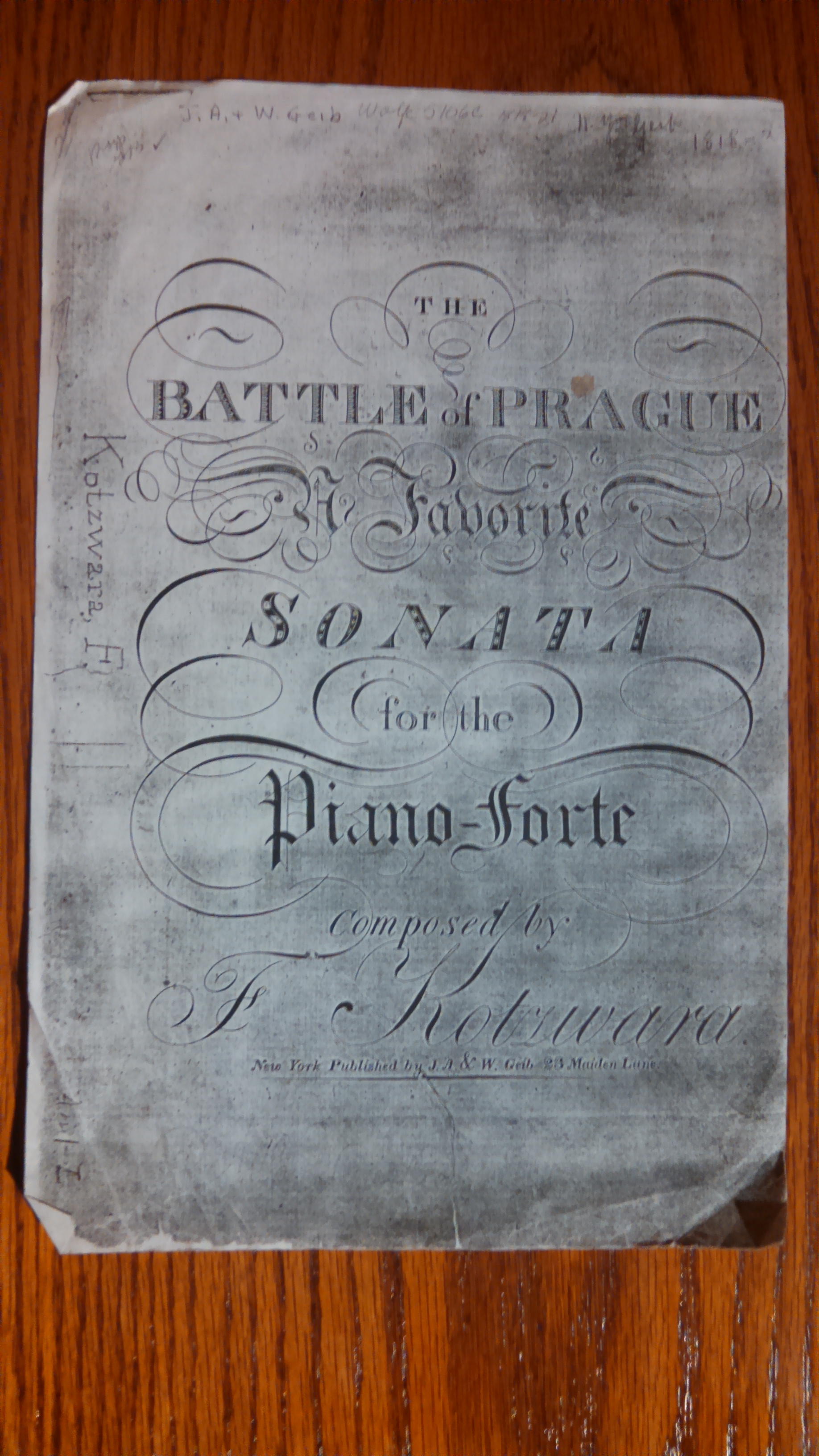 |
The Battle of Prague: A
Favorite Sonata for Pianoforte by F.
Kotzwara
Slow March; Word of Command
(2:03);1st signal cannon (2:31); the bugle call
for the Cavalry (2:34); answer to the first
signal cannon (2:48); the trumpet call (2:50)
The Attack (3:07) [score is marked "Prussian
imperialists"] [low notes beginning at 3:21 are
marked "cannon"] ; flying bullets (3:44)
trumpets (4:28); Attack with swords (Right
hand)/horses galloping (left hand) (4:43);
Trumpet Light Dragoons Advancing (bass notes
marked "cannon") (5:00); heavy cannonade (5:09);
cannons and drums in general (5:27); running
fire (5:35); trumpet of recall (6:24) [those
last three flourishes in the bass are actually
marked "cannon"!];
Cries of the Wounded (6:48); The Trumpet
of Victory (8:05); God Save the King (8:29);
Turkish Music (9:42); Finale (10:10) ; Go to
Bed, Tom (10:55); Tempo Primo (11:02) [a return
to the original tempo of the finale]
|
Kind of makes war sound like a
lot of fun, doesn't it?
|